Friday, July 13, 2012

Batman-a-thon Part 2: Batman (1989)

[Note: These links will be available as the reviews are posted: Batman (1966)/Batman Prime, Batman Returns, Batman Forever, Batman and Robin, Batman Begins (2005), The Dark Knight (2008), Batman Awards Blog]

Batman's television series ended in 1968, following three seasons of what can only be described as a Silver Age fan's hallucinogen-prompted wet dream. While the tone of the comics naturally shifted to suit the original readers from the Golden Age, no one really took note of the Dark Knight being, well, dark.
That is, until Tim Burton came to the Batman universe and created what was seen for about two decades as an incredibly dark take on the character. What proceeded to be created was Batman and Batman Returns.

I will get to the latter tomorrow, but today, let's focus on the original of Burton's creations.

First of all, I would like to note that this is one of the few Tim Burton films I've seen that did not feature Johnny Depp, which gives it a unique place in my understanding of Burton. From what I've seen, Burton's non-Depp films turn out to be excellent (at least in their first incarnation - See: Nightmare Before Christmas).

This time, the leading man was Michael Keaton. I will say this, I LOVE Keaton as Batman, but I DESPISE Keaton as Bruce Wayne.

Keaton played Wayne as Batman without the cowl. Wayne is a brooding character, but he puts on far more of a facade than Keaton did. Keaton's Wayne was depressing at best and bland at worst. I feel like Burton might have been aiming for that, but Batman should not seem like the more interesting person to hang out with in comparison to a billionaire playboy.

Anyway, the film starts with the origin for all of one scene. I will say that this was done beautifully and sets the tone for the film. It sets the movie as a stark contrast from the 60s series, where the tragedy of Wayne and Dick Grayson were barely even alluded to.
I'm a little undecided on the fact that Jack Napier (played by Jack Nicholson and the eventual Joker) kills Bruce's parents and not Joe Chill. On one hand, with the Joker being set for only one film, this gives a circular dimension to the film where Batman and Joker effectively create each other, and that's great.

On the other hand, the contrast between Batman's serious, orderly, justice-based demeanor and Joker's loose, random, anarchy-based mindset are a product of circumstance, not calculated as is clearly the case with Joker's comic character.

Overall, I like it for this film, and it fits with the style of story Burton wanted to tell.

After the origin, the film goes right into Bruce being established as Batman. He's been around for some period of time, and I like that. Given the Joker story that was coming, I don't need to see Bruce's long training sessions.

Batman ultimately stops Napier - a second-in-command of the mob at the time - from robbing a chemical factory and sends him into a vat of chemicals that turns his skin white, his hair green and his lips red. Additionally, a batarang cuts Napier's face, scarring his face into a jester's smile, causing him to name himself the Joker.

Between all of that, Vicki Vale and Alexander Knox are introduced as reporters looking for Batman. It is then that Vale and Bruce begin their "romance."

I say that because Keaton's acting with Vale provides very little heat (albeit more than in some films). This romance was little more than a plot device and served as the least interesting major theme of the film.

By contrast, Napier's takeover of the mob and subsequent scenes with Vale and Batman steal the show. Nicholson plays the Joker the way you'd expect Nicholson to: over the top, silly at times but ultimately threatening and psychotic.

It really seems clear that Nicholson got top billing in this film, as he just steals the show and Batman is practically his foil. Then again, that's kind of the point of the Joker character: He's the focus of Batman's energy and by the end, it's more a Joker story than a Batman story (See: The Killing Joke).
Joker's ultimate killing technique is to use a mixture of chemicals to kill a person in a way that gives them a post-mortem grin. This technique has been used in the comics as well as the Animated Series and it's genuinely terrifying if you think about it.
When Batman stops the initial plan by destroying the factory, Joker decides to hold a parade and use lethal gas to kill everyone in town. I'm not sure why people jumped at this chance, which is a weak point, but mob connections and the already-established corrupt police department make it fairly believable.
Oh, and during this time Alfred lets Vicki into the Batcave and Bruce organizes with her to destroy the factory (because Joker also seems to like Vicki, though with most Joker stories, his motives are never as easy to pin down as one would like). I am actually OK with this reveal individually, though I dislike the concept in general on the principle that it literally happens with EVERY love interest with the exception of Batman Prime and Batman and Robin. 

After the parade is stopped, Joker kidnaps Vicki and has one final fight with Batman. The two realize each other's identity and that they are responsible for each other's existence just before Batman wins and Joker falls to his death.
Following the fight, Commissioner Gordon and Harvey Dent (who has a very minimal role here) accept Batman and create the Bat-signal. I guess here it's seen that Gordon respects the role Batman tries to play and accepts the help, whereas in Batman Begins, the pre-Gordon commissioner dislikes any vigilantism.
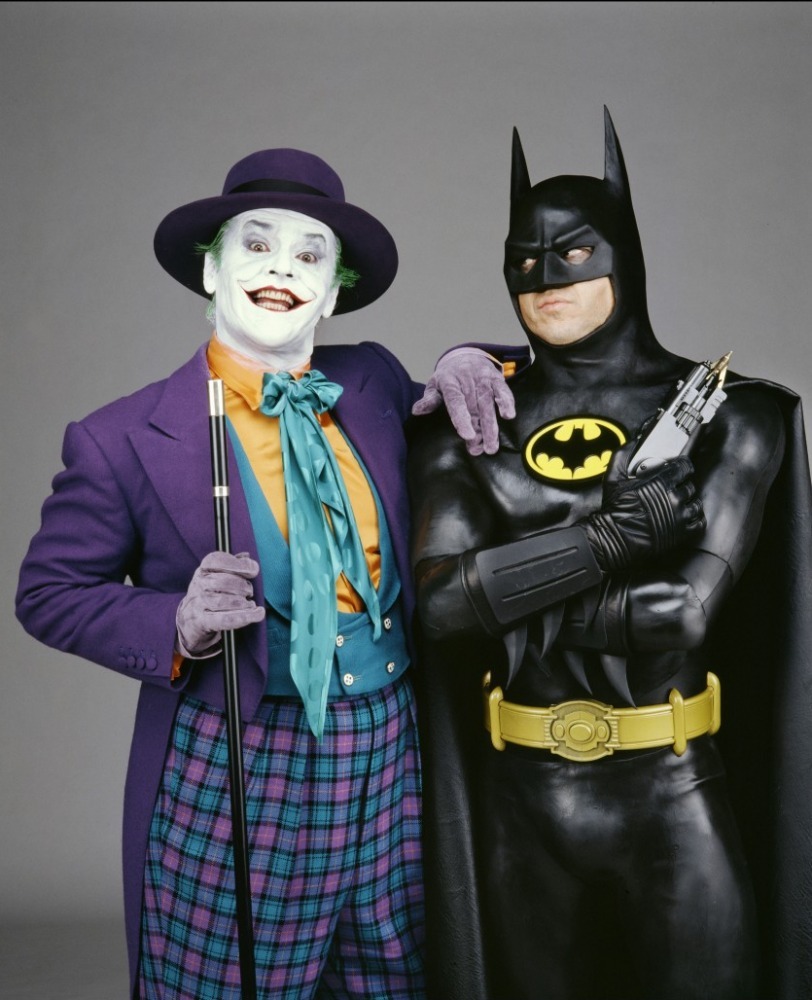
This film is more iconic for what it represents now than it is a legendary masterpiece, but it is still a great Batman film. It's a fairly accurate portrayal of a Batman vs. Joker storyline, although liberties were heavily taken with the origin.
This was the live-action Batman image I think of when I think of Batman, specifically the opening scene where he's threatening the small-time thugs. These Batman scenes are done wonderfully.
What drags the film, though, is the Bruce Wayne scenes. One thing I feel can be said about Tim Burton is that he does the surreal so well that when he tries to get down-to-earth, his work is bland by comparison.

I think the film Charlie and the Chocolate Factory shows that point perfectly. The factory is so surreal and interesting, but the Charlie character up until that point is just a chore to listen to and the world is uncomfortably creepy for some reason. The factory was what made the film strong (Depp's performance as Wonka excluded), and it's the only thing that gives the film something to hang its hat on vs. the original.

As I'll explain in my next review, that balance really begins to show in the sequel, as the non-Batman scenes get even more unsettling. However, this film balances out the creepy enough that the bland nature doesn't detract from the Batman story as a whole (with the exception of the random Prince songs and dance routines. That was just awful.).
On reputation and absolute, kick-ass strength of the hero scenes, weighed against the boring but not overly deterring Bruce scenes this film gets rounded up to 3 stars out of 4 and gets a 7.2 out of 10. 
I feel weird having this below Batman Prime, but that film did hold to its source material and stayed on focus with its plot (no matter how insane it was). This one had a better plot, but it only made up about half the film. It shifted tone like crazy and got distracted, I felt. I can see the strong story and excellent work but I also see the aspects of the movie that took me out of the film, and it came at the cost of the score.

Tomorrow is Batman Returns, so everyone come back tomorrow! 

-- 'Like' the blog's Facebook page at http://www.facebook.com/#!/SeanNetworkBlogs
-- Follow my Twitter at twitter.com/seantherebel

Thursday, July 12, 2012

Batman-a-thon Part 1: Batman (1966)

[These links will become active as the blogs are written: Batman '89, Batman Returns, Batman Forever, Batman and Robin, Batman Begins (2005), The Dark Knight (2008), Batman Awards Blog]

The Silver Age of Comic Books holds an interesting place in the hearts of comic fans.

Older fans remember it as the days when many of the current heroes - Justice League of America, the Avengers, Spider-Man, the Barry Allen Flash and Hal Jordan Green Lantern, etc. - either were created or really took off. It's the era where science really replaced magic as the dominant theme of plot.

Younger fans, however, look at it also as the era where books stayed well within the Comics Code Authority's restrictions. Storylines were completely insane or implausible (even for the universe they took place in) and campiness was inserted into characters who had once been dark and demented.

As such, there is a divide over how to look back on the Batman TV series of the 1960s, starring Adam West and Burt Ward as the Dynamic Duo.

It's hard to believe a show can be derided for its campy, patently surreal nature while also being so instrumental to the Batman Universe.

Not only did the show provide a much-needed spike to the declining sales at the time, but it led to the creation and recreation of so many parts of the character (Barbara Gordon being Batgirl, Mr. Zero being renamed Mr. Freeze, just to name a few notable examples).

I myself became a Batman fan not through the Animated Series (which aired when I was getting into cartoons), but through reruns of the 60s series. Maybe it's just me (and Grant Morrison), but I consider the goofy side of Batman to be just as much a part of the Batman mythos as the brooding side.

Granted, numerous universe-altering crossover events have stripped much of those storylines away, I still understand its importance enough that I believe I can give a somewhat more objective view on the 1966 film, Batman.

Now, to differentiate this film from the 1989 version of the same name, I will call that one Batman and I'll call this one Batman Prime, as it was the original non-serial, live action Bat-flick.

This film, airing between the first and second season of the show, starts off with the Duo getting a tip that someone needs to be rescued in the ocean. This turns out to be a trap set by the four (yes, four!) villains in this film: the team of the Joker (Cesar Romero), the Riddler (Frank Gorshin), the Penguin (Burgess Meredith) and Catwoman (normally Julie Newmar, but played by Lee Meriweather in this film).

The trap leads to the scene this film is known for: Batman descends into the water and is attacked by a shark, which thrashes unconvincingly on his leg like the rubber shark it clearly is. He then is forced to use his Shark Repelling Bat-spray to get it off. That's right, folks. Batman's contingency plans and prep time have allowed him to invent Bat-Shark Repellent.


THAT is the power or prep-time people! OK, so this was stupid and ridiculous when it was being written, but the fact is, this is what the Silver Age was. (See: Alien mutant corn spraying acid at Batman and Robin).

The thing is, for all of this madness, this feels epic. Four of Batman's greatest enemies teaming up, and honestly, they all put out great performances.

I still say that Penguin and Catwoman have been defined by their actors in this series, and though Meriweather is not as good as Newmar, she is a damn close second.

My only gripe is that of the four, the Joker got the least amount of play. The Riddler teased Batman with his riddles, Penguin was the mastermind, Catwoman was the James Bond-esque romantic interest/double agent. And Joker, well...

He was the Silver Age Joker.

Not that it's necessarily bad, and Cesar Romero stole any scene he was given the chance to laugh. However, he did so little that was of consequence it was clear they didn't have much of a plan for him.

He was very much like Hawkeye in the Avengers film. He was there because the plot only makes sense with him, but he never had a point where he was the focus. Joker was the "funny one" in this film, and he did it well. I just wish he had gotten to really execute something on his own and not just bounce off the others.

Anyway, the plan for the Crime Syndicate is that they want to use a dehydration machine to turn the U.N. stand-in's leaders to dust (It's the Silver Age, just go with it.) and hold them for ransom.

They test the machine on five henchmen, and Penguin poses as a victim to enter the Batcave for testing, where he unleashes the henchmen.

I'll say, that plan is actually brilliant. Sadly, it goes nowhere as the henchmen are revived with hard water instead of soft, turning the men into anti-matter. (If you bought the science that caused this, can you really complain about the side effects?)

Actually, both the Penguin and Catwoman have moments of brilliance here. Catwoman posing as Soviet journalist Miss Kitka and leading Bruce Wayne into a trap was done nearly perfectly, and I actually felt for Batman when Catwoman's mask falls off and he realizes the girl he started to fall for was a lie all along.

(Sidenote: How is it that THIS is the film whose romance felt the least forced? It seems like the less brooding you make Batman, the better chance you have of making the romance scenes not suck.)

So, the Duo makes it into the submarine for the final battle, but not before falling out of the sky into a pile of rubber and solving two of the strangest riddles ever.

They find the dehydrated leaders and Robin suggests that in order to promote peace, they alter them to not be so stubborn; however, Batman tells him that it is not their place to alter free will.

Unfortunately, the piles were not re-separated properly, and the leaders are revived in the bodies of other leaders. (Don't you hate it when you get dehydrated and then are revived in the wrong body?)

Batman does not think that trying to fix the situation would be safe for the leaders, knowing that a small mistake could reduce them to antimatter, and he hopes that the mixing of minds helps the world somehow, leaving before the inevitable angry mobs from these nations come to start a riot.

Overall, I have a lot of fun watching this film. It does what a comic book movie should do: entertain the audience.

Yes, it's insane. Yes, Adam West and Burt Ward's monologues and bizarre tangents are hilariously serious. Yes, even the actors had to make fun of insane situations (such as the 3-4 minutes where Batman is running around the docks with an already detonating bomb). And I LOVE every minute of it.

This film does one thing that no other Batman film can claim. It is an exact replica of the comic. If you ever tried to imagine a Silver Age comic coming to life and being done in Hollywood, this is the film you would see.

No other Bat-flick was as true to its source era as this one was. Whether that era translates to the big screen or should have representation in cinema is another discussion entirely.

So for all of its absolute madness and critique, it deserves credit for doing something epic that no other Batman movie can claim: It used more than two villains, heck, it took the four A-list villains of its era, and made a legitimately entertaining film with a feel of high stakes.

Those who think this feels like a defense may be right. But the fact is, we know what is wrong with the film. I want to show that there was a lot right with it as well.

For being true to the character of the era, having real action and a compelling romance (how it did that, I still have no idea) Batman Prime gets 3 out of 4 stars from me and a 7.6 out of 10.

Stay tuned for the film that got Batman back to non-print prominence, Batman (1989).

Also, starting today, I want to advertise my Facebook page and Twitter account.
 -- 'Like' the blog's Facebook page at http://www.facebook.com/#!/SeanNetworkBlogs
 -- Follow my Twitter at twitter.com/seantherebel

Wednesday, July 11, 2012

Prelude to a Batman-a-thon

If it wasn't apparent to the readers of this blog that I am a fan of The Batman, how's this one work for you? I LIKE BATMAN!!!

The Caped Crusader returns to the big screen next Friday with "The Dark Knight Rises," and I am genuinely pumped to be able to go to the midnight showing, even if it is in a theater in San Diego during my cousin's wedding week.

But while this will end the "Dark Knight Trilogy" that Christopher Nolan has put out, this is actually the eighth Batman film to make it to theaters (ninth if you count the Animated Series' "Mask of the Phantasm").

I won't be discussing the animated film, as I feel like it should fall in with the series and SubZero, but over the next few days, I will discuss every Batman live-action, non-serial film ever made.

I will begin tomorrow with Batman from 1966 - AKA the Adam West film. It's very Silver Age and very campy, if you need a reminder. You'll see.

Friday will be the 1989 Batman film with Michael Keaton and Jack Nicholson. Saturday and Sunday will bring Batman Returns and Batman Forever, respectively.

Monday, being the awful day that it is, will get Batman and Robin. (Ugh.) Tuesday and Wednesday will be Batman Begins and The Dark Knight.

Finally, Thursday will be my thoughts on which films did what best. Best Bruce Wayne. Best Batman. Best Villain. You get the picture.

I would note that my criteria will be less about who stays true to the dark, brooding Batman of the modern age, but who stays true to the Batman of their era or Batman in general, so if Adam West gets a better review than you would give it, there is a logic ot it and hopefully it will be understood by the end of it.

I know this will be a controversial style, and some conclusions will be mind-blowing, but I am a fan of ALL Batmen, so I hope you enjoy the ride. See you tomorrow!

Tuesday, July 10, 2012

Five reasons why people should quit whining about the Spider-Man reboot

I feel like I'm on a hot streak right now with my two blogs. For the first time in a while, I have a lot of ideas flowing at the same time.

Today, I have a thought that might annoy quite a few people: There are critics of The Amazing Spider-Man film need to shut up.

I'm not talking about the ones who simply didn't like the movie. Everyone has different tastes.

The ones I'm referring to are the ones who have been criticizing the film simply because it's not the Sam Raimi trilogy.

There has been a lot of trolling about how there should have been a Spider-Man 4 instead of a reboot, that it's too soon and that the cast was too iconic.

As such I want to address five reasons why the reboot was worthwhile. Before I do, though, I will address a common complaint: The rehashing of the origin.

A lot of people didn't like that, once again, the first third of a Spidey film dealt with the spider bite and Uncle Ben. I heard someone talk about how Tim Burton's Batman film and "The Dark Knight" are considered better than things like "Batman Begins" because the origin isn't necessary - that it works better when the hero has been around for a while and is able to jump right into a story.

I won't say it's a stupid argument because it's not, but I will disagree to an extent. First off, Tim Burton did use the origin - it just happened to only last for the opening scene. But the origin of a hero, while obvious to much of the viewers, can be good for a story when done right. I'd say Batman Begins did it very well, and that film holds up incredibly well against other Batman films. (By the way, leading up to "The Dark Knight Rises," keep an eye out for my thoughts on each Batman film.)

Besides, Superman's first film is considered better than its sequels and half the film was his origin, so that argument isn't iron-clad.

Additionally, I'd argue the origin was needed in this case to help the reboot become established. Peter was back in high school, which means that his powers couldn't have been around long, if at all. The movie sensed this, and redid the story. This is not the same series, and it's not a sequel, which leads me to No. 5:

5. This set up a new universe for sequels

This rebooted film did a great job making me want more, and it's good because the staff has committed to a trilogy.

The Lizard in the original universe would have been hard to do because of how little he was set up to look like he could be a threat. This is a similar problem the original Two-Face had in Batman Forever - he wasn't given much characterization in the original film, so everything was rushed in to set up his transformation.

However, here it was much more believable. Connors didn't seem as OK with not having an arm and he appeared far more willing to be desperate.

More importantly, though, his work at Oscorp sets up the Green Goblin again and one more villain (I vote Hobgoblin or Scorpion) to be seen at some point. Heck, if later on they decide to do Venom I'd be thrilled. The character can be fun if done right, which leads to No. 4.

4. Spider-Man 3 damaged the original storyline to the point that a reboot made more sense

I honestly do wish Spider-Man 3 wasn't the last of the original storyline. I wouldn't mind a fourth installment, and people are upset that no writer could come up with something.

But let's be honest here: There is nothing to set up.

Harry Osborn dies, Sandman was sent away and Venom was killed off. No villain was immediately set up, whereas the first and second film were building for Harry's turn.

Venom was wasted in a throwaway role when he should have been set up to be the fourth movie's villain. The origin story was revisited and bastardized. And so many plot points - Peter and the secretary, Harry having amnesia to take him out for a while, Harry's turn happening quickly because of a butler, etc. - went nowhere and in some cases killed chances to build the universe further.

The only storyline not resolved was the romance, but it was so botched that I didn't walk away wanting another film to resolve the freaking thing.

The Peter-MJ romance had come to a great point of growth after the second film, but it regressed back to poor communication and indecisiveness. It reached the point where I was fine if they just let Peter switch for Gwen. And that's No. 3

3. Gwen will be done properly

Gwen Stacy had no business being in the first set of films. She was nothing like the original character and had no way of going through her tragic arc. Heck, had the film called her Felicia Hardy instead, there might have actually been a REALLY good storyline for the fourth film.

Here, Gwen appears to be a useful character and is far stronger as a love interest than Mary Jane was for Peter in the originals.

I'm not sure if she will be taken out in the second or third film, but I'd guess third since there don't seem to be plans past a trilogy and setting up MJ in even movie 2 would be hard to bring to a decent conclusion in a two-film time frame with Gwen still around.

This is one instance where a mulligan was needed immediately from Raimi's version, which leads to No. 2.

2. Five years is plenty of time to reboot

I hate that people say it's too soon to reset the universe. Batman Begins was seven years after Batman and Robin and got critical acclaim.

Two years fewer is not that big a difference, especially when the tone of the film has changed so much. I could understand if the film wasn't comparably good, but that's point No. 1.

1. THIS FILM WAS BETTER THAN THE ORIGINAL FIRST INSTALLMENT

This is not to say that Spider-Man 1 was bad. I enjoy it a lot. I'd even say that Norman Osborn in that film was played better than Dr. Connors in this film (and their developments into their villain forms are nearly identical), but there are big differences here.

The Lizard actually looked tough compared to the Green Goblin, whose suit looked goofy like it was from a Silver Age Spider-Man adapation.
For some reason this reminds me of Lord Zedd.

While Goblin had no real plan after Norman's job was safe other than to hurt Spidey, it was cool seeing the Lizard have a plan and to even call it a gift.

Where Mary Jane's looks were at their best in the first film, her acting wasn't at the form it was in the sequel, and I never felt emotionally invested in her.

Gwen Stacy is an inherently better love interest when starting from the origin because you know what will happen to her. This is coupled with how John Stacy dies and reminds the audience of what will happen by warning Peter to stay away from her.

Mary Jane never felt like she was in danger of being killed off whereas with Gwen it's expected. The challenge is making people forget that during the film and actually become tied into a doomed character. And like jerks, these writers have perfectly tied us to her, making us root for her survival when the odds are slim-to-none.

While the job as Peter is about even, but Andrew Garfield reflects the superhero alter ego far better than Tobey Maguire did. He's not whiny and appears to have the tough-guy mentality that would create a wise-cracking Spider-Man. And he's actually competent at being proactive and trying to find a villain's next attack while Maguire reacted more than he acted.

As I said, Willem Dafoe is the only real thing about the original that beats the remake, so I say that this trilogy is off to a far better start. I'd go as far to say that the film is comparable to The Avengers and between the two, I'm more interested for Spidey's sequel.

Of course, we all have different views, so I may be considered wrong. However, that won't mean much to me while I'm enjoying the new films. If you haven't seen it, check it out!

Sunday, July 8, 2012

Some updates on my comic reviews

So for those who don't know me directly, I recently got hired to work at the main newspaper in my home-metropolis of Las Vegas.
As such, my schedule will need to become more streamlined after this month. I've already pretty much set up a specific workout regimen for my martial arts training, and now I need to figure out when my blogs will be able to come out.

MMA blog followers will be glad to know that I have no intention of cutting any UFC previews and  I will give thoughts on the major events. However, Bellator previews may be merely picks for the most part.

On this blog, I will still review two weeks a month; however, I won't be doing anymore wild card picks, as they are too difficult to maintain since I have to research the storylines. Additionally, I am considering cutting Batgirl from my reviews because of the five titles, it is currently the weakest and I want to get down to two reviews a week.

If the audience wants me to continue with Batgirl, though, feel free to leave comments and maybe I'll keep the book on tap.

For those who came for Batman, Batman & Robin, Red Hood & the Outlaws or Nightwing, nothing will be changing. Those four will still be reviewed regularly.

Additionally, with the new Dark Knight film coming out in two weeks, look for me to do some reviews of the previous Batman films, from the original 1966 film to both entries of the current trilogy.

Hopefully I'll be able to budget some time well once I have my schedule set, and this blog will have a pretty solid schedule by August.

Thursday, July 5, 2012

Avatar: The Last Airbender - The Promise Part 2 Review

Those who watched the sequel series to Avatar: The Last Airbender, "The Legend of Korra," caught a glimpse into the future of what the Avatar world became after the 100-year war ended in the original series.

However, the series goes so far into the future that a lot of events between the end of the flagship series and the start of its spin-off can only be guessed at. This is what "The Promise" trilogy hopes to help fill in - at least in the immediate year or so after the series ended.

I reviewed the first part of the trilogy in a blog linked here, but this is where I review Part 2, which could be summarized as the part where Tokka fans got beyond a butt-load of cannon fodder.

This story can be taken in three different storyline focuses. The 'A' story appears to be Aang and Katara's trip to the Earth Kingdom, the 'B' story looks like Zuko's interactions with his father and people around him, and the 'C' story is Toph and Sokka's fight for the metalbending academy (AKA the part that all my friends just won't shut up about).

The book opened with more of Kataang shoving their relationship in our fac... uh, being a loving couple. I joke, but this relationship has actually been beautifully done. Goofy pet names in battle aside, this has given the new relationship feel perfectly and, as I'll mention later, is showing natural growth and development as the two go from trusting each other in training and on the battlefield, to trusting on an emotional, spiritual level.

Anyway, the 'oogie-'ness drives Sokka insane and Toph suggests he come with her. The rest of their story focuses on Toph's metalbending students, all of whom are completely insane, trying to keep their school.

The firebenders who once owned the school come back to retake control of the building, but Toph wants to keep it. So Sokka, in his comic-relieving brilliance, creates a contest where the students who knock an opponent on their butt win control of the school. (That Republic City council would be of quite some use here, huh?)

So the three students were selected by Toph because they were all emotional wrecks, which she thought might make bending easier because they were in tune with extreme emotions. This leads to one of the dumbest-yet-still-funny scenes of the book where Sokka tries to spur their fear.

Overall, Toph and Sokka bounce off each other so well and they really match their characters from the series about as perfectly as one could hope. However, it was still only a tangential Tokka story until the end of Zuko's storyline.

The focus on Zuko is his conversations with his father, Ozai. The former Fire Lord tells Zuko a story from when Zuko was young and used it to basically say that morality is relative, not a unified cosmic truth.

This is actually a great discussion that I am so glad was put into the book. Not only is Ozai able to pinpoint exactly how political leaders think and how international politics develop in regard to nations exiting war, but he makes Zuko deal with a choice as to whether he should enforce his will on the situation or not.

Ultimately, this leads to Mai confronting Zuko about his conversations with Ozai and a very weird romantic moment between Zuko and Suki (probably; it's hard to convey tone in written works).

But yeah, if the threat of a Zuki 'ship freeing up Sokka for Toph isn't a way to make Tokka people go absolutely nuts, then writers do a LOT of stuff on accident. Honestly, I don't mind if Tokka did not produce Lin in the sequel series, but at some point in the lifespan of the characters I want that relationship to be canon if only to make "The Serpent's Pass" have more significance than ending Aang's emo arc and setting up Ba Sing Se.

The final major storyline is Kataang reaching Ba Sing Se and meeting with Earth King Kuei - but not before boarding for a night with Aang's fangirl club. At last, there is a bit of testing of the relationship, as Katara feels jealousy at Aang having so much fun with these bunch of obsessive freaks, only to see that Aang only enjoyed their company because they remind him of the Air Nomads.

For the first time in The Promise, this relationship has some growth. I love how the relationship isn't just that honeymoon period, lovey-dovey thing and Katara actually feels some doubt. At the same time, the relationship strengthens because despite all the doubt, the relationship was never in danger, and that realization should make the audience feel more confident that the two are meant to be. Well done.

There is a side story about how the assassin from the first part of the story is dating Sneers from the Freedom Fighters, but it means very little to the plot right now. If Part 3 makes it important, I'll dwell on it more.

Overall, this is a must-read for Avatar fans, and I'd still say it's on par with some of the arcs in the actual series. I would love for this to become an ATLA TV movie at some point.

Feel free to continue the discussion here, and I'll see you for Part 3 in September.

Saturday, June 23, 2012

Comic Book Reviews: Nightwing #10 and Red Hood & The Outlaws #10

The first two Robins have their entries into my reviews this week. Let's take a look at them.

Nightwing #10

I was incredibly impressed by the work done for Nightwing in this issue, especially by the characterization of Dick wanting to improve Gotham his way, not Bruce's.

His plan to rebuild the historic district is something that is patently of Dick's mind, and the fact that he's desiring to avoid working with Bruce's money on it is something interesting. A lot of people brought up that it is weird for him to be in talks with Tony Zucco's daughter, but the way DC's continuity has been recently, I wouldn't be shocked if her part in Dick's history is completely gone. As such, this could be a chance for her to start their history over, and so I'll withhold judgment.

I'm into the idea of a cop trying to undermine the Bat-family by using old Nightwing weapons as ways to frame him. It keeps with the divided police department theme that has run throughout the early, six-year history of Batman. (That still gets to me.)

Also, how often has Lucius Fox appeared so far in the Bat-verse? He's not been a very frequent character, and I liked the long bit of dialogue that he was given here.

My only concern with this new story is that it has the same secret society feel as the Court of Owls, which they just literally came out of. The team will have to be careful as to not make this gang of teens a knock-off of the Court.

Overall, this is an excellent investment of time and money, and I hope that this arc can continue to build off the strong start.

Red Hood and the Outlaws #10

I have been a fan of Starfire since watching her in the Teen Titans TV series, and have since read Wolfman-Perez era stories that have made me really enjoy the character.

While I enjoy the Starfire of this book, she appeared to be lacking in much of what made her awesome initially. This issue provides a better glimpse of it as Starfire does something epic: She leads a fleet of intergalactic military ships as a ruthless war commander.

There is a nice amount of humor in this book, don't get me wrong, and I enjoyed that as well. Jason and Roy both were on point with the running commentary on the situation, and Roy has slowly become my second-favorite Starfire love interest (behind Dick Grayson, of course).

The best part of the commentary is that Jason's most recent date comes along for the ride and is rightfully freaked out. I would have no problem with her becoming a recurring character after this arc ends.

There is a side story with Essence to finish the book. Honestly, it was a nice piece, and it's good to see what's happening with the Untitled storyline, but it did cut off what had been an amazing plot to that point. I would have rather this sidestory been a standalone issue than taking up parts of multiple books.

Still, it's worth the price of admission and there's a big selling point for next issue when next month's title is teased. Not going to give it away because the mark-out moment is the best thing of the issue, but those who know Starfire's history will understand why I'm excited.